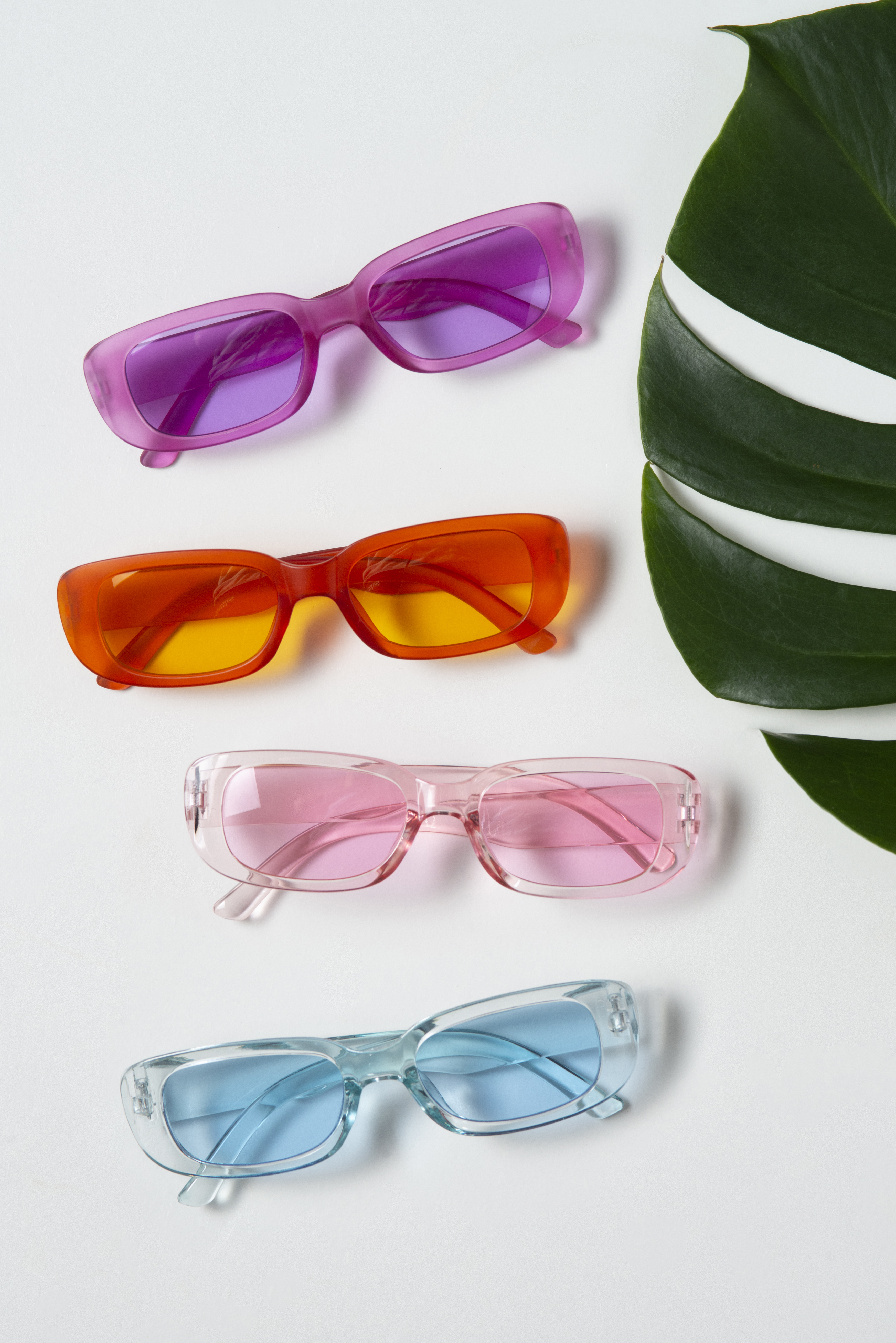
Summer’s intense sunlight and ultraviolet (UV) rays are invisible killers, not only causing sunburn but also significant damage to the eyes. UV rays can penetrate the cornea and lens, reaching the retina at the back of the eye. Over time, this can damage the retina and lens, and even lead to eye diseases. Therefore, sunglasses, which offer both sun protection and style, have become the preferred choice for many to protect their eyes. But when buying sunglasses, we see various colored lenses. Do different colors offer different functions?
- Do different lens colors offer different functions?
Sunglasses lenses come in many colors, the most common being brown, gray, green, yellow, and red.
Brown lenses: Brown lenses filter out a large amount of blue light, improving visual contrast and clarity, making them suitable for use in heavily polluted or foggy conditions.
Gray lenses: Gray lenses effectively reduce light intensity and absorb infrared rays and 98% of UV rays without altering the original colors of objects.
Green lenses: Like gray lenses, green lenses effectively absorb infrared light and 99% of ultraviolet rays. However, green lenses can distort the colors of certain objects, and their light-blocking effect is slightly less than that of gray lenses.

Yellow lenses: absorb 100% of ultraviolet rays and allow infrared light and 83% of visible light to pass through. Yellow lenses absorb most blue light, making natural objects clearer. Therefore, yellow lenses are often used as filters.
Red lenses: filter 95% of ultraviolet rays and some shorter wavelengths of visible light, and are recommended for use in changeable weather conditions.
- How to Choose the Right Sunglasses?
When choosing sunglasses, don’t just consider the style; functionality is more important.
Choose sunglasses with UV protection labels. Always buy sunglasses from reputable stores. When purchasing, look for labels such as “100% UV protection,” “UV400,” or “UV protection” on the packaging.
Darker lens colors are better. For people who work outdoors for extended periods, choose sunglasses with darker lenses, as these help filter strong glare. Gray, brown, and greenish-gray are the top choices, as they absorb the spectrum evenly, have minimal color difference, and better meet the needs of everyday lighting. Light-colored sunglasses are suitable for wearing in low sunlight or for short periods outdoors.
The lens surface should be smooth, without scratches or bubbles. Hold the sunglasses 50cm away from your eyes and observe vertical and horizontal lines around you, such as window or door frames, through the lenses. Then move the sunglasses up and down and back and forth. If you notice any distortion or wobbling in the straight lines, the lenses are deformed and should not be worn. Lenses that are uneven, scratched, or have bubbles will cause dizziness or other discomfort when worn and should also be avoided.